Every year, a new programming language (or framework) explodes on social media.
“Learn Rust now!”
“Go is the future!”
“This language will replace everything!”
At the same time, languages like Java, Python, C++, and PHP continue quietly running banks, startups, governments, and half the internet.
So what’s the smarter move in 2026?
Should you learn a trending language riding the hype wave — or a stable, proven language that’s been around for decades?
Let’s break it down properly.
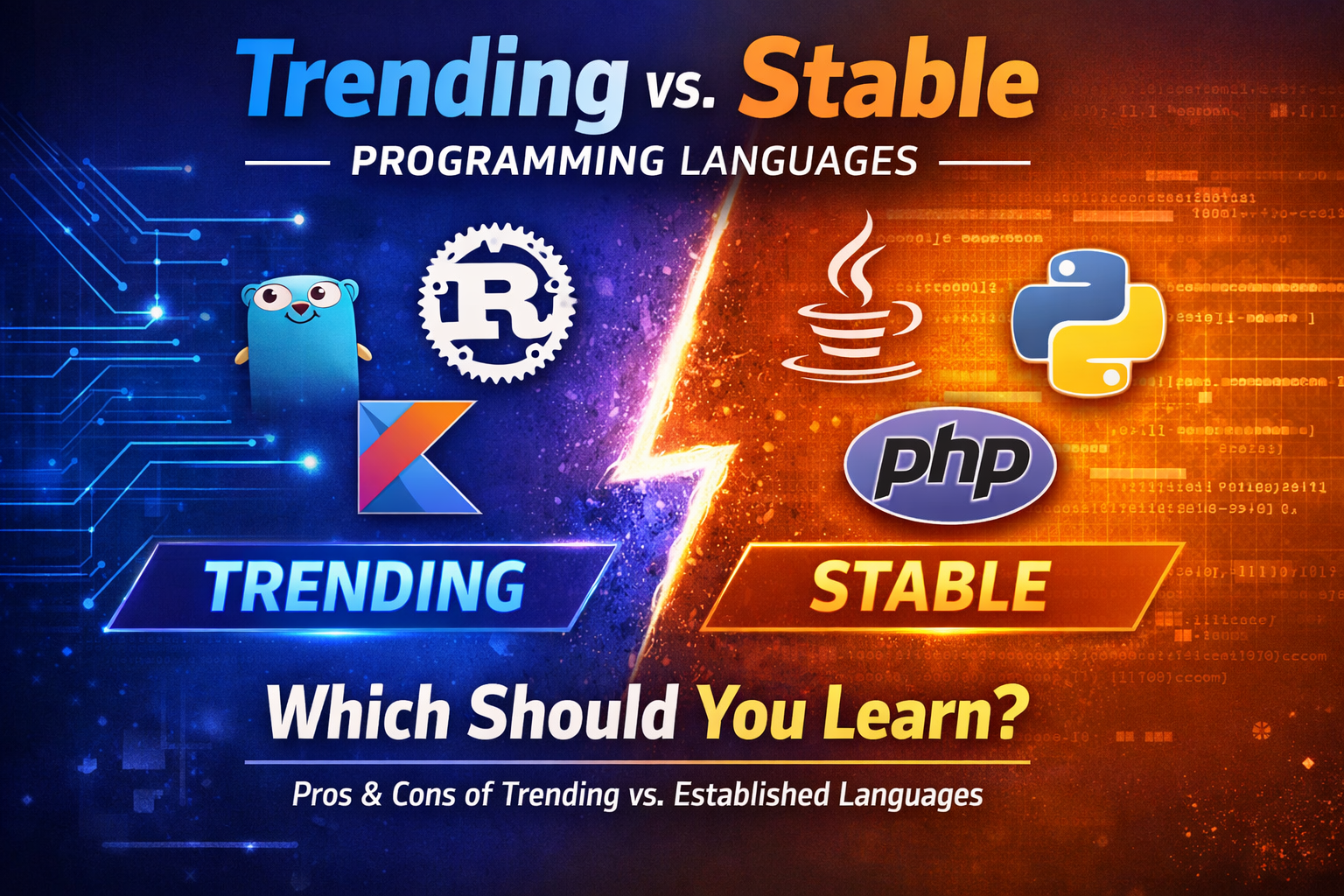
What Are Trending Languages?
Trending languages are those experiencing rapid growth in popularity, adoption, or community interest. These languages often:
-
Show fast growth in GitHub activity
-
Trend in developer surveys
-
Attract strong startup adoption
-
Get praised for solving modern problems
Examples (depending on current trends):
-
Rust
-
Go
-
Kotlin
-
Swift (when it first surged)
-
TypeScript (during its rapid rise)
They usually promise:
-
Better performance
-
Improved developer experience
-
Memory safety
-
Modern tooling
-
Cleaner syntax
And honestly? They’re exciting.
What Are Stable Languages?
Stable languages are battle-tested. They’ve been around for years (sometimes decades) and power massive ecosystems.
Examples:
-
Java
-
Python
-
C++
-
C#
-
JavaScript
-
PHP
They:
-
Have huge communities
-
Offer mature frameworks
-
Power enterprise systems
-
Have massive job markets
-
Have extensive documentation and learning resources
They may not always be “cool,” but they’re reliable.
The Case for Learning Trending Languages
Let’s be fair — trending languages aren’t just hype.
1. Early-Mover Advantage
If you learn a language before it becomes mainstream, you can position yourself as an early expert.
When TypeScript was new, early adopters gained strong leverage in frontend jobs. The same happened with Go in cloud development.
2. Better Design & Modern Concepts
Many new languages are designed with modern development challenges in mind:
-
Concurrency
-
Security
-
Cloud-native systems
-
Microservices
-
Performance optimization
Rust, for example, was built around memory safety from day one.
3. High Growth Potential
If a trending language gains massive adoption, demand can outpace supply — meaning higher salaries and better opportunities.
Startups especially love modern stacks.
The Risks of Chasing Trends
Now here’s the uncomfortable truth.
Not every trending language survives.
Some fade.
Some stay niche.
Some never grow beyond hype.
Learning a language purely because it’s trending can lead to:
-
Limited job openings in your region
-
Small ecosystems
-
Fewer learning resources
-
Instability in long-term career growth
Trend-driven decisions can be risky if you don’t evaluate the bigger picture.
The Case for Learning Stable Languages
Stable languages dominate real-world production systems.
1. Massive Job Market
Java, Python, and JavaScript consistently rank among the most in-demand languages globally.
Enterprise companies rely on stability over hype.
2. Long-Term Career Security
Languages that have survived 15–25 years are unlikely to disappear suddenly.
Banks don’t rewrite their systems every 3 years.
Governments don’t rebuild infrastructure because something new appeared on Twitter.
3. Rich Ecosystems
Stable languages offer:
-
Mature frameworks
-
Battle-tested libraries
-
Tons of tutorials
-
Large communities
-
Clear career paths
If you get stuck, someone else already solved your problem.
The Downside of Stable Languages
They can feel:
-
Less exciting
-
Slower to evolve
-
Overcrowded in entry-level markets
Also, some older languages carry legacy design decisions that newer ones try to fix.
But stable doesn’t mean outdated.
Many “old” languages constantly evolve (just look at Java, Python, or PHP updates over the years).
So… Which Should You Choose?
Here’s the honest answer:
It depends on your goal.
If You’re a Beginner
Start with a stable language.
Why?
You want:
-
Abundant learning resources
-
Large communities
-
Easier job entry
-
Transferable fundamentals
Languages like Python, JavaScript, or Java teach core programming concepts that apply everywhere.
Once you understand fundamentals, picking up trending languages becomes much easier.
If You’re Mid-Level or Experienced
Now you can experiment.
Learning a trending language can:
-
Expand your technical depth
-
Open niche opportunities
-
Increase your value in specialized markets
-
Make you adaptable
At this stage, adding Rust, Go, or another modern language can be a strategic upgrade.
The Smart Strategy: Don’t Choose One — Combine Both
This is where most developers go wrong.
It’s not “trending vs stable.”
It’s:
Stable foundation + selective trend awareness
For example:
-
Learn JavaScript → then add TypeScript.
-
Learn Python → then explore Rust for performance systems.
-
Learn Java → then explore Kotlin.
-
Learn PHP → then explore modern backend alternatives.
Your core language gives stability.
Your secondary language gives growth leverage.
Think in Terms of Ecosystems, Not Just Languages
Sometimes the question isn’t about the language — it’s about the ecosystem.
Ask yourself:
-
Is this language growing in cloud computing?
-
Is it adopted by startups?
-
Is it strong in enterprise?
-
Does it align with AI, DevOps, or mobile development?
Languages don’t exist in isolation.
They exist in industries.
Final Thoughts
If you chase every trend, you’ll never go deep.
If you ignore every trend, you’ll become outdated.
The real advantage in 2026 isn’t knowing the “hottest” language.
It’s:
-
Strong fundamentals
-
Adaptability
-
Continuous learning
-
Strategic curiosity
Trends come and go.
Stable systems endure.
The best developers know when to build on rock — and when to surf the wave.